
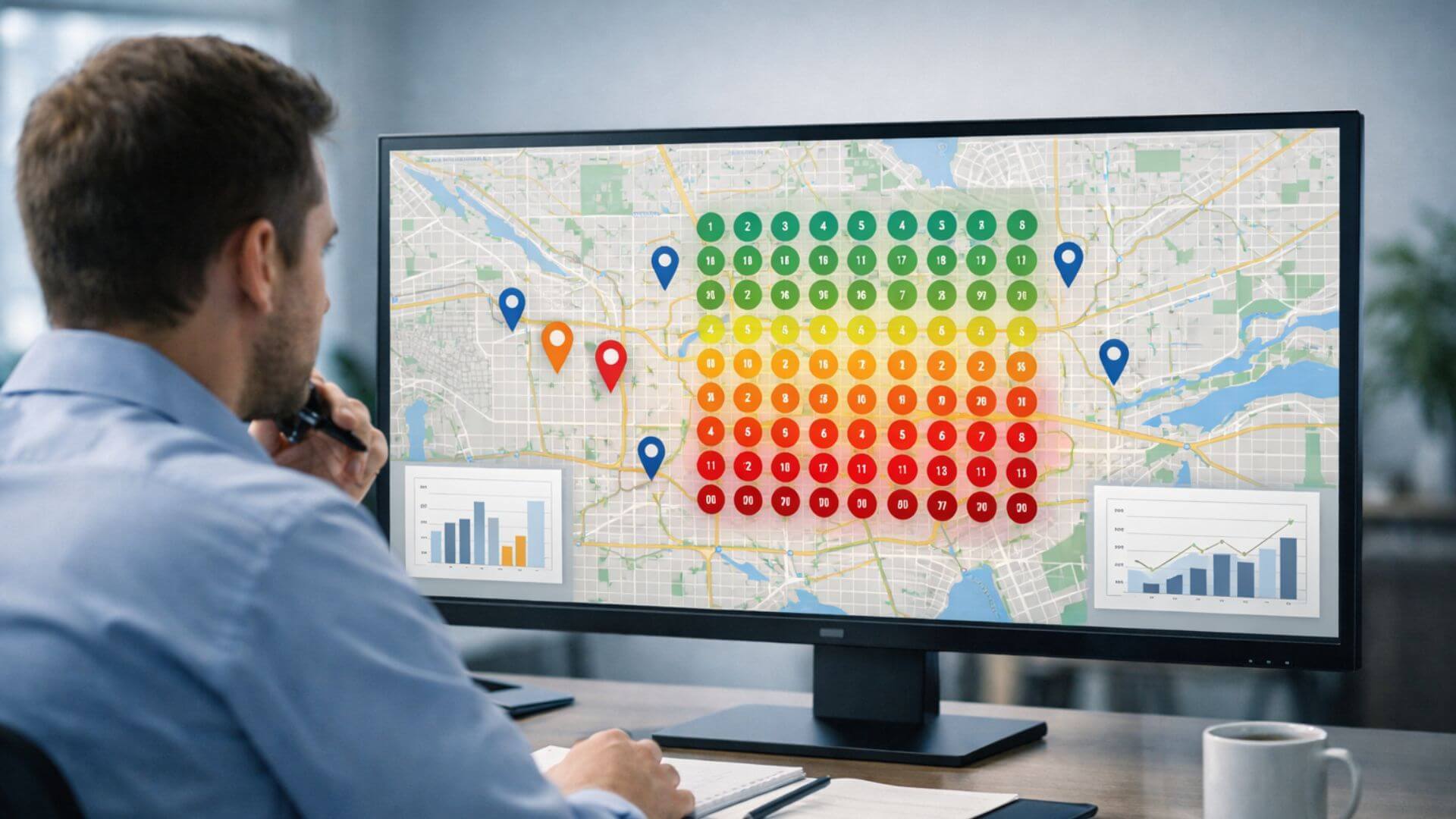
Competitor Google Maps ranking tools matter because manual searches do not show the full picture. When you check rankings from your own device, Google personalizes results based on your location, search history, and account activity. This makes manual checking unreliable for real competitor comparison.
Google Maps rankings also change by exact location. A business can rank #1 on one street and disappear three miles away. Without proper tracking, you cannot see these visibility gaps. This is why many businesses misunderstand their real map pack position.
Competitor Google Maps ranking tools solve this problem by collecting structured, location-based data. These tools track positions across multiple geographic points, compare competitors side by side, and measure ranking movement over time.
Instead of guessing, you get:
In competitive markets, data-driven tracking replaces assumptions. It allows you to understand where competitors outperform you and where real growth opportunities exist.
A reliable maps ranking tracker must measure more than a single keyword position. Google Maps rankings depend heavily on location and competition, so tracking must reflect real-world search behavior.
The right tracker shows where you rank, how competitors rank, and how visibility shifts across your service area.

Location is the core factor in Google Maps visibility. A strong maps ranking tracker must measure rankings across multiple points, not just one central address.
This data helps separate proximity influence from true optimization strength.
Tracking only your position is not enough. You must compare performance directly against competitors.
A good maps ranking tracker turns raw ranking data into structured insights that support smarter local SEO decisions.
Not all local rank tools track Google Maps rankings the same way. To measure map pack performance correctly, you need tools designed specifically for local visibility – not general SEO tracking platforms.
Understanding the differences helps you choose the right tracking method.
Local rank tools usually fall into two categories:
For map pack accuracy, grid-based tracking is usually more reliable.
Organic ranking tools track website positions in standard search results. Google Maps tracking tools measure local pack positions inside Maps results.
These are not the same. A business can rank well organically but perform poorly in the map pack. Local rank tools must separate these datasets clearly.
Proximity strongly affects Maps rankings. A listing may rank #1 near its address but drop significantly a few miles away.
Proximity-based tracking:
Accurate local rank tools account for proximity so you can measure performance realistically and improve visibility strategically.
Using competitor Google Maps ranking tools correctly turns raw data into strategic insight. Follow this structured process to track visibility without guessing.
Start by listing the main services you and your competitors offer. Focus on non-branded keywords that trigger map pack results. These shared service keywords create a fair tracking baseline.
Avoid tracking too many keywords at once. Select high-intent terms that directly drive calls and leads.
Configure the tool to scan a geographic grid that reflects your real service area. A wider grid shows coverage strength, while a tighter grid highlights core ranking zones.
Grid-based tracking reveals where competitors outrank you and where you dominate.
Run competitor Google Maps ranking tools on a consistent schedule. Weekly tracking helps you spot:
Consistency matters more than daily checking.
Focus on trends instead of single data points. Look for patterns such as:
Trend analysis shows whether changes result from optimization, proximity shifts, or market competition. This step transforms tracking into actionable strategy.
Maps ranking analysis turns raw tracking data into clear competitive insight. When you study ranking grids and position trends, patterns start to appear.
First, data reveals where competitors consistently outrank you. You may notice that certain neighborhoods, zip codes, or service zones show repeated visibility gaps. These are not random shifts – they reflect strength differences in relevance, proximity, or prominence.
Second, tracking shows who appears together in the map pack most often. Ranking overlap highlights direct competitors and exposes which businesses dominate high-value areas.
This analysis connects directly to strategy. Instead of making random profile edits, you can:
For deeper insight into interpreting tracking data correctly, review our related guide on Maps ranking analysis. When used properly, ranking analysis replaces guesswork with structured local growth decisions.
Competitor Google Maps ranking tools provide powerful data, but incorrect use leads to wrong conclusions. Avoid these common mistakes to keep tracking accurate and strategic.
Correct use of competitor Google Maps ranking tools focuses on trends, geography, and structured comparison – not isolated data points.
Using local rank tools consistently helps you detect real trends instead of reacting to noise. The right tracking frequency depends on your market and competition level.
In most industries, weekly tracking provides a balanced view. It allows you to spot:
Monthly tracking works only in low-competition markets where rankings remain stable. However, monthly checks may miss early warning signs.
Highly competitive industries require more frequent monitoring. In these markets:
Low-competition markets experience slower movement, so less frequent tracking may be sufficient.
Increase tracking frequency when:
Local rank tools are most effective when used strategically. Consistent monitoring ensures you respond to real trends – not temporary fluctuations.
Competitor tracking data becomes valuable only when you turn it into structured action. Raw ranking numbers do not improve visibility – strategic adjustments do.
When you analyze competitor trends, you can identify:
This data supports focused optimization instead of random edits. Instead of changing multiple profile elements at once, you adjust one area based on clear evidence.
Structured improvements reduce risk. Sudden, large changes often trigger instability in Google Maps rankings. Controlled updates – based on tracking insights – help strengthen visibility without creating new problems.
A professional Google Maps ranking service uses competitor tracking data to guide safe, data-driven optimization. The goal is not to chase competitors daily, but to build steady, sustainable growth across your service area.
Manual ranking checks work only in simple situations. As your market becomes more competitive or geographically complex, manual tracking fails to show accurate visibility patterns.
Businesses that serve multiple cities or wide geographic zones cannot rely on one-location searches. Rankings vary significantly across neighborhoods, zip codes, and city boundaries. Without structured grid tracking, large visibility gaps remain hidden.
Multi-location companies face an added challenge. Each location competes differently based on proximity, competition, and category alignment. Manual checks make it difficult to compare performance between branches or detect internal overlap issues.
In competitive industries, rankings shift quickly due to constant optimization and competitor activity. Manual tracking cannot capture subtle movement trends or ranking volatility across multiple keywords.
In these cases, structured competitor tracking tools become essential. They provide consistent data, broader geographic coverage, and reliable performance comparison – something manual searches cannot deliver accurately.
Use this checklist to ensure competitor Google Maps ranking tools provide reliable, actionable insights instead of misleading data.
Following this checklist keeps tracking focused, consistent, and aligned with long-term Google Maps growth.
Competitor Google Maps ranking tools replace guessing with measurable data. Instead of relying on occasional manual searches, you gain structured insight into where you rank, where competitors dominate, and where growth opportunities exist.
Consistent monitoring builds clarity. Weekly tracking shows patterns, not just position numbers. Over time, this data helps you separate temporary shifts from real competitive changes.
Competitor tracking should not be a one-time activity. Local search evolves constantly, and ongoing analysis keeps your strategy aligned with market movement. When tracking becomes part of your routine, Google Maps growth becomes more predictable and sustainable.