

Google business attributes help Google understand your business more clearly. They act as structured signals that explain important details about your services, facilities, and customer experience. When attributes are accurate and complete, Google gains better context about what your business offers.
Attributes also influence discovery searches. When users search for businesses with specific features – such as wheelchair access, delivery options, or online appointments – Google uses attributes to decide which profiles to show. Even if your category is correct, missing attributes can reduce your chances of appearing for these intent-based searches.
It is important to understand that attributes do not directly change rankings like reviews or proximity. Instead, they affect profile visibility by improving relevance and clarity. Profiles with complete and accurate attributes often appear more often in filtered searches and attract higher engagement because users quickly see that the business meets their needs.
In simple terms, attributes help your profile qualify for more searches and appear more useful to users. While they do not guarantee higher rankings on their own, they support long-term visibility by making your Google Business Profile more relevant and trustworthy.
Google relies on visibility attributes to understand the specific features and capabilities of a business. These attributes help Google decide whether a profile matches what a user is searching for, especially when searches include filters or detailed intent.
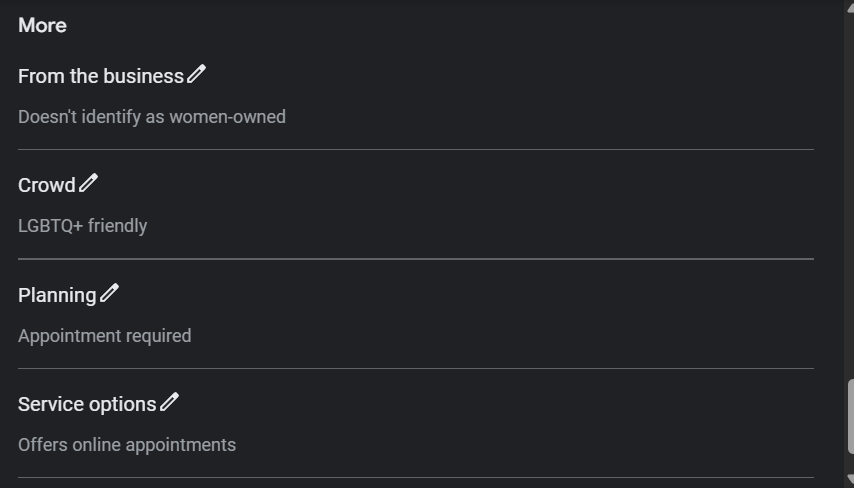
Attributes work as context signals that tell Google more about how your business operates. When you select attributes such as accessibility options, service methods, or amenities, Google uses this information to understand what customers can expect.
Google reads attributes differently from the business description. The description is free-form text, while attributes are structured data. Structured data is easier for Google to process and trust. Because of this, attributes often carry more weight when Google filters results based on specific features.
Attributes help clarify details that may not be obvious from categories or descriptions alone. This clarity improves how accurately your profile appears in relevant searches.
Categories and services define what type of business you are and what you offer. Attributes support this information by explaining how those services are delivered or what features are available.
Attributes do not replace categories or services. Instead, they strengthen them. For example, a category tells Google your business type, services explain your offerings, and attributes highlight important features that influence customer choice.
Attributes become decisive for local intent when users apply filters or search for specific needs. In these cases, profiles with matching attributes are more likely to appear. Accurate attributes help your business qualify for these intent-driven searches and improve overall visibility without changing your core ranking position.
There are several types of google business attributes that help Google and users understand your business better. Each attribute type highlights a different aspect of how your business operates and what customers can expect. Selecting the right attributes improves clarity, relevance, and engagement.
GMB highlights showcase important features that customers often look for before choosing a business. These highlights appear prominently on your profile and help users quickly decide if your business meets their needs.
Popular business highlights include:
These highlights improve click-through and engagement because they answer common user questions instantly. When users see features that matter to them, they are more likely to interact with your profile, visit your location, or contact your business.
Service-related attributes explain how your services are delivered. These attributes are especially important for service-based businesses and help set clear expectations.
Common service-related attributes include:
These attributes reduce friction by clarifying the service process. They also help Google match your profile with users searching for specific service conditions.
Product and offering attributes focus on how customers can buy or receive your products. These attributes are important for retail, food, and hybrid businesses.
Common product and offering attributes include:
These attributes improve trust and usability by showing customers how they can access your products. They also support discovery searches where users filter results based on delivery, pickup, or shopping preferences.
Using the right mix of attributes helps your Google Business Profile appear more complete, relevant, and user-friendly. Accurate attribute selection strengthens visibility and supports better engagement over time.
A complete and accurate set of google business attributes helps Google understand how your business operates and what customers can expect. Each attribute group sends a different type of signal that supports relevance, filtering, and engagement in local search.
Below is a structured list of attribute groups and what each one signals to Google.
Accessibility attributes tell Google whether your business is usable for people with mobility or accessibility needs.
Examples include:
These attributes help your profile appear in accessibility-focused searches and filters. They also improve trust and usability for users who rely on these features when choosing a business.
Payment attributes explain how customers can pay for your products or services.
Examples include:
Payment attributes reduce uncertainty and improve user confidence. Google uses this information to improve search results for users who filter by payment options.
Service option attributes describe how services are delivered.
Examples include:
These attributes help Google match your business with users searching for specific service methods. They are especially important for intent-driven discovery searches.
Health and safety attributes highlight precautions or standards followed by the business.
Examples include:
These attributes increase trust and help Google understand how your business addresses customer safety concerns. They can influence user decisions during sensitive or high-consideration searches.
Amenities and feature attributes highlight comfort, convenience, or added value.
Examples include:
These attributes support engagement and click-through by answering common customer questions. They help your profile stand out when users compare similar businesses.
Selecting the right attributes across these groups makes your Google Business Profile more informative and easier to match with relevant searches. While attributes do not directly boost rankings, they significantly improve visibility by helping your profile qualify for more search scenarios and filters.
Many businesses overlook Google Business Profile attributes or use them incorrectly. These mistakes limit visibility and reduce how accurately Google understands the business. Avoiding these issues helps attributes support discovery and engagement instead of becoming wasted signals.
One common mistake is leaving attributes empty. When attributes are not selected, Google has less information to work with. This can prevent your profile from appearing in filtered or intent-based searches where attributes play a key role.
Another issue is selecting inaccurate attributes. Choosing attributes that do not reflect your actual operations may confuse users and reduce trust. Inaccurate attributes can also lead to poor user experience when customers expect features that are not available.
Many businesses also ignore updates when business operations change. Attributes should reflect current conditions. If services, amenities, or policies change, attributes need to be updated as well. Outdated attributes weaken profile accuracy and visibility over time.
Treating attributes as optional is another mistake. Attributes are not just extra details – they are structured signals that help Google and users understand your business. When used correctly, attributes support relevance and improve how often your profile appears for the right searches.
Avoiding these common mistakes ensures that attributes remain accurate, useful, and aligned with your real business operations.
Attributes play a supporting role in strengthening your services and categories. When used correctly, they reinforce what your profile already claims instead of trying to replace core optimization work. This is why attributes work best as part of broader service optimization elements, not as standalone features.
Services and categories tell Google what your business does. Attributes confirm how those services are delivered and what customers can expect. For example, a service may claim onsite support, and an attribute like “onsite services available” validates that claim. This alignment improves clarity and reduces ambiguity for both Google and users.
Attributes also help validate service claims through consistency. When your services, categories, and attributes all point to the same business reality, Google gains higher confidence in your profile’s accuracy. This consistency supports relevance in discovery searches and improves engagement because users see reliable, matching information across the profile.
It is important to view attributes as supporting signals, not ranking shortcuts. Attributes do not replace categories, services, or reviews. Instead, they strengthen those elements by adding structured context. When attributes, services, and categories work together, your profile becomes more complete, trustworthy, and easier for Google to match with the right search intent.
Using attributes strategically helps reinforce service optimization without overloading or confusing your profile.
Attributes play an important role in strengthening how products appear and perform in a Google Business Profile. When used correctly, they act as product visibility signals that support listings and help Google understand how customers can access your offerings.
Product-related attributes support listings by adding structured details that product descriptions alone may not clearly explain. Attributes such as in-store shopping, delivery available, or pickup options give Google and users immediate clarity. This helps your products qualify for more filtered and intent-based searches.
Attributes are especially important for pickup, delivery, and availability. When users search for products they want to buy quickly or conveniently, Google relies on these attributes to show the most relevant businesses. Profiles that clearly state how products can be purchased are more likely to appear when users apply filters or search with specific needs.
Product-related attributes also improve user trust. Clear signals about availability, fulfillment options, and shopping methods reduce uncertainty before a customer takes action. When users feel confident about how they can buy or receive a product, they are more likely to engage with the profile, visit the business, or make contact.
Attributes should be seen as supporting signals rather than standalone features. When product listings, attributes, services, and categories all align, your profile sends clear and consistent signals. This alignment improves visibility, strengthens trust, and supports better performance across product-focused searches.
Managing Google Business Profile attributes becomes difficult as a business grows or operates across multiple services or locations. Attributes change over time as offerings, policies, or amenities evolve. Keeping every attribute accurate and aligned at scale requires regular attention and a structured process.
Accuracy and consistency are critical. Incorrect or outdated attributes can confuse users and weaken visibility in filtered and intent-based searches. When attributes do not match services, categories, or real business operations, Google may reduce trust in the profile. Regular reviews are needed to ensure that selected attributes still reflect how the business actually operates.
This is where professional support becomes useful. Businesses that want predictable visibility often rely on a structured gbp optimization service to manage attribute audits, consistency checks, and ongoing updates as part of a complete optimization system. Instead of reacting to visibility drops, this approach helps maintain clarity and relevance over time.
Using an optimization service makes sense when attributes need continuous monitoring, frequent updates, or alignment across multiple profile elements. A managed process ensures that attributes remain accurate, up to date, and supportive of long-term visibility goals rather than becoming overlooked details.
Before finalizing or updating your attributes, use this checklist to ensure everything is accurate and complete. A quick review helps prevent visibility issues and keeps your Google Business Profile aligned with real business operations.
Following this checklist helps ensure that attributes remain useful, accurate, and supportive of long-term local visibility.
Google Business Profile attributes work best when they are accurate, complete, and aligned with how your business actually operates. Well-selected attributes help Google understand your business more clearly and help users decide whether your profile meets their needs. Inaccurate or incomplete attributes reduce this clarity and limit visibility.
Ongoing updates are just as important as the initial setup. As services, products, or policies change, attributes should be reviewed and updated to reflect those changes. Regular maintenance prevents outdated information from weakening trust or filtering your profile out of relevant searches.
Attributes should be viewed as long-term visibility support signals, not quick ranking tools. When combined with accurate categories, services, products, and reviews, attributes strengthen relevance and improve how often your profile appears for the right searches. Treating attributes as part of an ongoing optimization process helps maintain steady visibility and supports sustainable local search performance over time.