

A google business service description helps Google and users understand exactly what a business offers. It adds clarity to your profile by explaining each service in simple terms. When service descriptions are clear and accurate, Google can match your business more easily with relevant searches.
Service descriptions also support discovery searches. When users search for a service without a specific business name, Google looks at service details to decide which profiles are relevant. Well-written descriptions increase your chances of appearing in these searches by clearly aligning with user intent.
It is important to understand the difference between service descriptions and the business description. The business description gives a general overview of your company, while service descriptions focus on individual offerings. Service descriptions are more specific and help Google understand the exact services you provide, rather than just your overall business type.
In short, service descriptions improve visibility by strengthening relevance, supporting discovery searches, and adding detailed context that categories alone cannot provide.
Google reads a google business service description as a structured source of information, not as marketing copy. The goal is to help Google understand what each service includes and when it should show your profile to users searching for that service.

Google processes service descriptions by looking for clear, meaningful information about the service. It focuses on what the service is, who it is for, and what it includes. Simple and direct wording helps Google match the description with relevant search queries.
Clarity matters more than marketing language. Promotional phrases, slogans, or exaggerated claims do not add value. Google prefers descriptions that explain the service in a straightforward way. Clear descriptions improve relevance and reduce confusion for both Google and users.
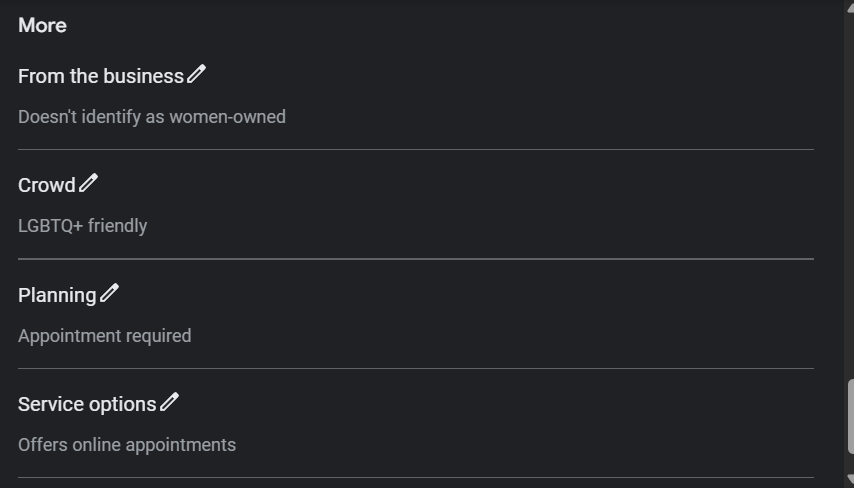
Service descriptions work together with categories and attributes. Categories tell Google what type of business you are, while service descriptions explain your specific offerings. Descriptions add detail that categories alone cannot provide.
Attributes add structured context, such as how services are delivered or what features are available. Service descriptions fit alongside attributes by explaining the service in more detail, while attributes confirm key features. When categories, descriptions, and attributes align, Google gains higher confidence in your profile’s accuracy and relevance.
A strong google business service description should explain the service clearly and help users understand whether it matches their needs. The goal is to provide useful information, not to sell aggressively. Focus on clarity, accuracy, and relevance.
When these three points are covered, the service description becomes informative, user-friendly, and easy for Google to understand. This improves relevance and supports better visibility in service-related searches.
Good service descriptions help users understand your offerings quickly and encourage them to take action. Following proven service writing tips improves readability, builds trust, and keeps users engaged with your Google Business Profile.
Write in simple, customer-friendly language. Use words that your customers naturally understand and search for. Avoid technical terms unless they are necessary, and explain them clearly if you must use them. Clear language makes your service easier to understand at a glance.
Keep descriptions short and focused. Service descriptions work best when they deliver information quickly. Focus on the main purpose of the service and avoid adding extra details that do not help the user decide. Short descriptions are easier to read on mobile devices, where most local searches happen.
Avoid unnecessary jargon. Industry buzzwords or internal terms may confuse users and add no value. Google also prefers clear and natural language that explains real services instead of abstract or promotional wording.
Using these service writing tips helps create descriptions that are clear, engaging, and effective for both users and search engines.
Not all service descriptions perform the same way. The quality of your GMB copies directly affects clarity, engagement, and how users respond to your profile. Understanding what works – and what doesn’t – helps you write descriptions that support visibility instead of weakening it.
Effective GMB copies focus on clarity and usefulness. They allow users to understand the service quickly and decide if it fits their needs.
Key traits of strong service descriptions include:
Good copies describe the service in plain language, explain what customers can expect, and avoid unnecessary claims. They feel helpful rather than promotional.
Poor-performing GMB copies usually fail because they lack clarity or focus too much on selling.
Common issues include:
Descriptions that use broad phrases or sales-heavy wording confuse users and provide little value. These copies make it harder for Google and customers to understand what the service actually offers.
Writing effective GMB copies means focusing on clarity, relevance, and user intent. When descriptions are specific and helpful, they perform better for both visibility and engagement.
Even small mistakes in service descriptions can reduce visibility and confuse users. Avoiding these common issues helps keep your Google Business Profile clear, accurate, and useful.
One mistake to avoid is keyword stuffing. Repeating keywords unnaturally does not improve visibility and often makes descriptions hard to read. Google prefers natural language that explains the service clearly. Keyword-heavy descriptions can reduce trust and weaken relevance.
Another issue is using sales-heavy or ad-style language. Service descriptions are not advertisements. Phrases like “best service,” “limited offer,” or aggressive calls to action do not help users understand the service. Clear, factual descriptions perform better than promotional copy.
Many businesses also make the mistake of copy-pasting the same description across multiple services. Duplicate descriptions add no value and make it difficult for Google to distinguish between different offerings. Each service should have a unique description that reflects what it actually includes.
Adding unrelated services is another common problem. Listing services you do not truly offer or that do not match your business category confuses users and weakens profile accuracy. Google relies on consistency, so unrelated services can reduce trust and visibility.
Avoiding these mistakes helps ensure that service descriptions remain focused, accurate, and aligned with real business offerings.
Service descriptions play a central role in how your services are presented and understood across your Google Business Profile. They are not isolated text fields. Instead, they connect directly with your overall service setup and help organize how Google interprets your offerings. This is why writing effective service descriptions requires a structured approach, not random wording.
Well-written service descriptions support relevance by clearly explaining what each service includes and who it is meant for. When descriptions align with your service names, categories, and attributes, Google gains a clearer picture of your business focus. This clarity helps your profile appear for more accurate service-based searches.
Service descriptions should be treated as part of structured optimization. They work alongside categories, attributes, and other profile elements to reinforce consistency. When everything matches – services listed, descriptions written, and attributes selected – your profile sends stronger and more reliable signals to Google.
Viewing service descriptions as part of a larger optimization system helps maintain long-term visibility. Clear, aligned descriptions strengthen relevance, reduce confusion, and support better performance across discovery and intent-based searches.
Service descriptions and attributes work best when they support each other. Descriptions explain your services in detail, while visibility-focused attributes confirm key features and conditions. When both align, Google and users gain a clearer understanding of what your business offers.
Service descriptions should reflect the same information shown in attributes. For example, if a service description mentions onsite support or online consultations, the related attributes should also be selected. This alignment reduces confusion and strengthens relevance signals across your profile.
Consistency between descriptions and attributes improves trust. When users see matching information in multiple sections of your profile, they feel more confident about your services. Google also prefers profiles where details are consistent and accurate, as this signals reliability.
Attributes help validate service descriptions by acting as structured confirmation. While descriptions provide context, attributes provide quick, scannable signals that support those claims. When both match, your profile becomes easier to understand, more trustworthy, and more likely to appear in intent-based searches.
Treating service descriptions and attributes as connected elements – not separate tasks – helps improve clarity, trust, and long-term visibility.
Writing a few service descriptions is manageable for a small profile, but the work becomes complex as a business grows. When you offer multiple services, operate in competitive markets, or manage more than one location, writing and maintaining service descriptions at scale requires a structured process.
Accuracy and consistency matter over time. Service descriptions must stay aligned with categories, attributes, and real business offerings. As services change, descriptions need updates to avoid outdated or misleading information. Inconsistent descriptions can confuse users and weaken visibility signals, even if other parts of the profile are optimized.
This is where professional support becomes useful. Businesses that want consistent results often rely on a structured GMB optimization service to handle service description audits, content updates, alignment with attributes, and ongoing optimization. Instead of reacting to visibility drops, this approach keeps descriptions accurate and relevant through regular reviews.
Using an optimization service makes sense when service descriptions need continuous monitoring, frequent updates, or coordination with other profile elements. A managed process ensures that descriptions remain clear, consistent, and supportive of long-term visibility rather than becoming overlooked text fields.
Before publishing or updating your service descriptions, use this checklist to ensure everything is clear, accurate, and aligned with your business. A quick review helps prevent common mistakes and supports long-term visibility.
Following this checklist helps keep your Google Business service descriptions useful, reliable, and supportive of consistent profile performance.
Clear and accurate service descriptions help both users and Google understand what your business offers. When descriptions explain services in simple language and match real offerings, they improve relevance and reduce confusion. This clarity supports better visibility in service-based and discovery searches.
Ongoing updates are just as important as the initial setup. As services evolve, descriptions should be reviewed and adjusted to reflect current offerings. Regular updates prevent outdated information from weakening trust or misrepresenting your business.
Service descriptions should be viewed as long-term visibility support, not a one-time task. When written correctly and maintained over time, they strengthen consistency across your Google Business Profile and support steady local visibility.