

Google does not rank businesses only based on categories and reviews. The Services section plays a direct role in how Google understands what your business offers. This is why google business services optimization matters for local rankings and visibility.
The Services section helps Google match your profile with specific search queries. When someone searches for a service you offer, Google looks at your listed services to decide whether your business is relevant. If your services are missing, unclear, or poorly structured, your profile may not appear – even if your category is correct.
Optimized services also improve visibility by clarifying your offerings. Instead of guessing from your website or description, Google uses the Services section as a structured signal. Clear service names and descriptions help Google understand your expertise, scope, and focus. This increases your chances of appearing in discovery searches where users are not searching for a brand name.
There is also a strong connection between services, categories, and local intent. Categories tell Google what type of business you are, while services explain what exactly you do. When services align closely with your primary and secondary categories, Google gains higher confidence in your relevance for local searches. This alignment helps your profile appear for the right searches in the right location.
In short, optimizing the Services section improves relevance, supports local intent matching, and strengthens your overall Google Business Profile ranking signals.
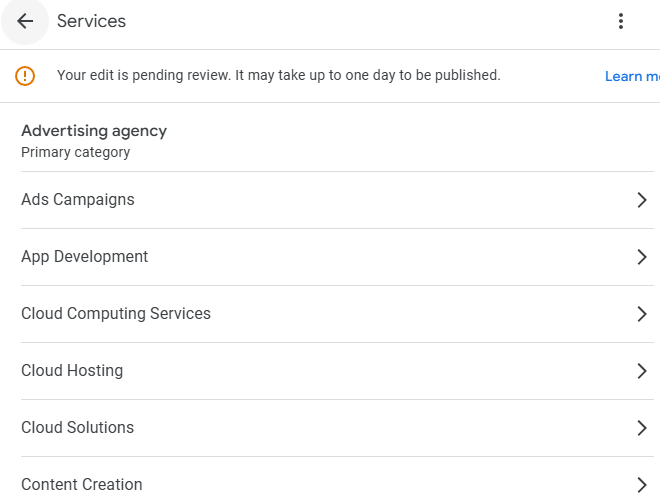
Google uses GMB services to understand what your business actually provides, not just what category it falls under. While categories define your business type, services help Google match your profile with specific user searches. This makes the Services section a key part of intent-based local rankings.
When someone searches for a service near them, Google scans service listings to decide which profiles are the most relevant. Clear and accurate services increase the chances of appearing in these search results.
Google reads service names and descriptions as structured relevance signals. Each service tells Google what you offer in a direct and organized way. When services are clearly named and properly described, Google can easily connect them with related search terms.
There is also an important difference between categories and services. Categories tell Google what kind of business you are, such as a plumber or marketing agency. Services explain what specific work you do, such as drain cleaning or Google Business Profile optimization. Without services, Google has less detail to match your profile with precise search intent.
Services work differently from keywords placed in business descriptions. While descriptions provide context, services act like structured keywords that Google can process more easily. This structure makes services more reliable for matching search queries.
Well-optimized services support discovery searches, where users search for a service without knowing a business name. When your services align with common customer searches, your profile becomes eligible to appear for more relevant queries. This is why properly set up services can expand visibility beyond brand-based searches and improve overall local reach.
Many businesses add services to their Google Business Profile but fail to optimize them correctly. Following basic service listing tips helps avoid errors that can limit visibility or reduce ranking potential. Even small mistakes in service setup can weaken how Google understands your offerings.
One common mistake is adding too many unrelated services. Listing services that do not closely match your business category confuses Google and reduces relevance. Google prefers focused service listings that clearly align with what your business actually provides.
Another frequent issue is copy-pasting the same service descriptions across multiple services. Repeated descriptions add no value and make it harder for Google to distinguish between offerings. Each service should explain a specific task or solution in clear, unique language.
Many businesses also ignore service relevance to categories. Services should support your primary and secondary categories, not work against them. When services do not align with categories, Google may struggle to match your profile with the right local searches.
Leaving services incomplete or generic is another mistake. Short, vague service names or empty descriptions provide little information to users or search engines. Clear, specific service details help Google understand intent and improve profile relevance.
Avoiding these common mistakes ensures that your service listings remain accurate, relevant, and useful for both users and Google.
A structured approach is the best way to handle google business services optimization. Instead of adding or editing services randomly, following a clear step-by-step process helps improve relevance, accuracy, and local ranking potential.
Start by reviewing all the services currently listed on your Google Business Profile. Check whether each service still reflects what your business offers today. Look for outdated services, unclear names, or services that no longer match customer intent. An audit helps identify gaps and issues that limit visibility.
Next, remove services that are unrelated or repeated. Duplicate services confuse Google and weaken relevance signals. Services that do not match your business focus or category should also be removed. A clean and focused service list helps Google understand your core offerings more clearly.
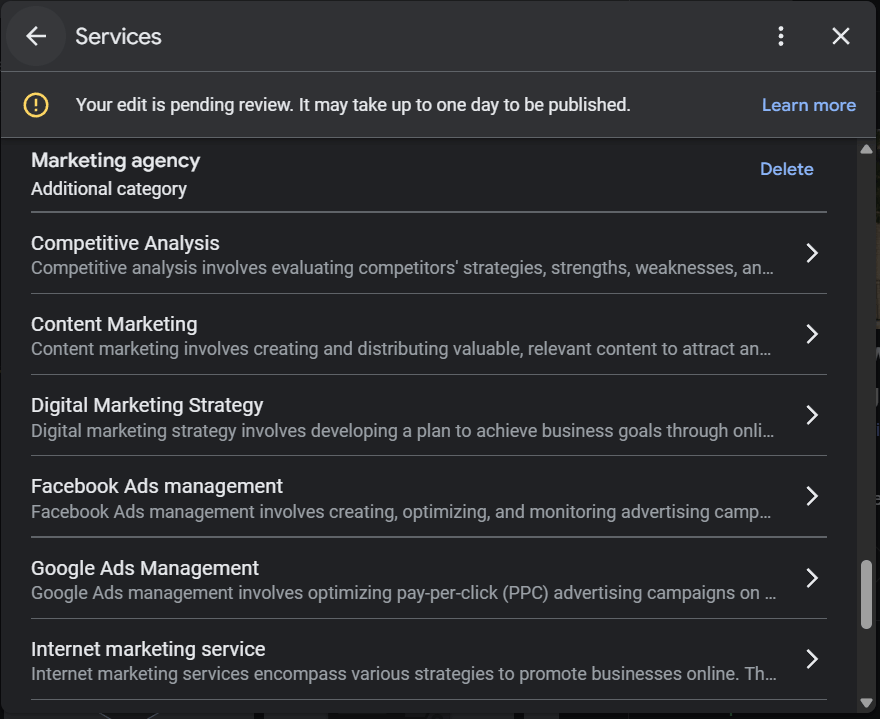
Finally, ensure that every listed service supports your primary and secondary categories. Categories define your business type, while services explain your exact offerings. When both align, Google gains stronger confidence in your profile’s relevance for local searches. This alignment improves visibility for service-based discovery queries.
Following this step-by-step optimization process helps create a clear, structured Services section that supports local ranking stability and improves profile performance.
Writing clear and optimized service names and descriptions is a key part of effective Google Business Profile optimization. This section helps Google understand exactly what you offer and helps users quickly decide if your business matches their needs. Poorly written services reduce relevance, even if they are listed correctly.
Service names should be clear, specific, and intent-focused. Each service name should describe one real offering in a way customers naturally search for it. Google uses service names as structured signals, so clarity matters more than creativity.
Best practices to follow:
Avoid keyword stuffing in service names. Adding extra words or repeating phrases does not improve rankings and can reduce clarity. One well-written, specific service name performs better than a long, keyword-heavy version.
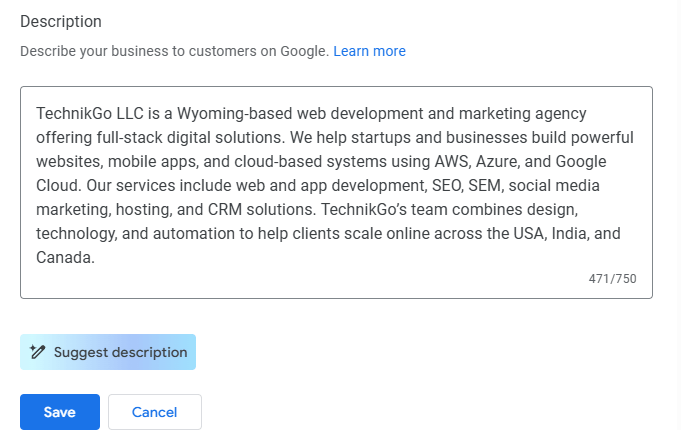
Service descriptions give Google and users additional context about what each service includes. Descriptions should read naturally and explain the service in a helpful way.
Key guidelines:
Matching customer search intent is critical. A good service description answers common questions users have before contacting a business. When descriptions align with how people search and what they expect, Google is more likely to show your profile for relevant discovery searches.
Well-written service names and descriptions improve relevance, strengthen service signals, and support better local visibility over time.

Service optimization does not work in isolation. Categories and services must support each other for Google to clearly understand your business. This is why service category setup plays a major role in how visible your Google Business Profile becomes in local search results.
Categories tell Google what type of business you are, while services explain what exactly you offer. When both are aligned, Google can confidently match your profile with relevant search queries. If categories are incorrect or too broad, even well-written services may struggle to perform.
Incorrect category setup weakens service optimization in several ways. Services may appear irrelevant if they do not logically fit under the selected category. This mismatch confuses Google and reduces trust in your profile’s accuracy. As a result, your listing may lose visibility for service-based searches.
In many cases, businesses should adjust categories before optimizing services. If your primary or secondary categories do not accurately reflect your core offerings, service optimization will have limited impact. Fixing categories first ensures that every service supports the correct business intent and improves overall relevance.
A well-aligned category and service structure creates a strong foundation for visibility. When categories clearly define your business type and services expand on that definition, your profile becomes easier for Google to understand and rank appropriately.
Optimizing services alone is not enough to achieve strong or stable local rankings. Services work best when they are part of a complete profile optimization strategy that keeps every section of your Google Business Profile aligned and accurate. Google evaluates profiles as a whole, not as individual elements.
Services must connect with other key profile signals. Photos support visual trust and activity, posts show ongoing engagement, reviews confirm credibility, and accurate business information builds consistency. When services align with these elements, Google gains higher confidence in your profile’s relevance and reliability.
For example, services listed on your profile should match what appears in your photos, posts, and customer reviews. If your services claim one thing but your photos or reviews suggest another, Google may reduce trust signals. Consistency across all sections strengthens how your profile performs in local search results.
Think of services as a structured layer within a larger system. They clarify what you offer, while other elements reinforce that message. When services, categories, photos, posts, reviews, and business details all work together, your profile becomes easier for Google to understand and more competitive in local rankings.
A unified approach ensures that service optimization supports long-term visibility instead of working in isolation.
Managing a Google Business Profile becomes more complex as your business grows. Updating services is not a one-time task – it requires regular audits, clear service structure, category alignment, and ongoing updates to stay relevant. For businesses with multiple services, locations, or frequent changes, handling this manually can quickly become overwhelming.
At scale, even small mistakes can impact visibility. Inconsistent services, outdated listings, misaligned categories, or duplicate entries weaken relevance signals. Regular audits are needed to ensure services remain accurate, descriptions match search intent, and updates reflect real offerings. Without a structured process, profiles often lose ranking stability over time.
This is where professional optimization becomes important. Businesses that want predictable results often rely on a structured google business profile optimization service that manages service audits, category alignment, consistency checks, and ongoing updates as part of a single system. Instead of reacting to ranking drops, this approach helps maintain long-term visibility.
Using a professional service makes sense when you want services to support rankings consistently, not work in isolation. A managed optimization process ensures that your Services section stays accurate, aligned, and effective as your business evolves.
Before finalizing your Services section, use this checklist to ensure your optimization is complete and effective. A well-structured checklist helps prevent common errors and keeps your profile aligned with Google’s expectations.
Using this checklist regularly helps maintain service accuracy, improve relevance, and support long-term local ranking performance.
Optimizing the Services section is not a one-time task. A structured approach to service optimization helps Google clearly understand what your business offers and improves how your profile appears in local search results. When services are accurate, relevant, and aligned with categories, they strengthen your overall profile relevance.
Ongoing review and updates are just as important as the initial setup. As your services change, expand, or improve, your Google Business Profile should reflect those updates. Regular audits help prevent outdated or irrelevant services from weakening your visibility over time.
When managed correctly, services become a long-term ranking asset. They support discovery searches, improve intent matching, and work alongside reviews, photos, and accurate business information. Treating the Services section as part of a broader optimization system helps maintain stable rankings and long-term local visibility.
By keeping your service listings structured and up to date, you build a stronger foundation for sustainable local SEO performance.